
As the spooky season approaches and more horror themed activities start to fill our agendas, you might consider playing a horror game. Or, if that doesn’t quite cut it for you anymore, you might be looking to make your own horror game.
If you aren’t a fan of horror to begin with, that very well could be that you just haven’t found the right thing for you. Maybe you were a horror fan until one day your heart started thumping a bit too hard after a jump scare. Understandable. Thankfully making them is a more blood pressure friendly activity.
Like many things in the world of video games, horror is one of those that we borrowed from literature and films, especially the later one. From horror movie tropes like jump scares or eerie music queues, we can draw a clear link between certain horror movies and their horror games counterpart, but the interactive nature of video games brings new ways of portraying horror that are unique to them.
I think it goes without saying that reading or watching horror is very different from playing a horror game. It can be chilling to read a horror book, your face half turned to the book as every line makes you squirm a bit more with descriptions of gore and bloody guts. But the actions are being taken by someone else, you’re just kinda there for the ride. In a game like The Mortuary Assistant, you do the pulling of the guts yourself.

I am one of those people that used to hate horror, then started loving it, then hated it for another bit and then came back around on it. While I don’t enjoy getting blood pressure spikes, I do love reading horror novels and watching shows like Guillermo del Toro’s Cabinet of Curiosity.
But in this back and forth dance that I was doing with horror, at some point I realized that for some reason, when I played a horror game it didn’t seem to affect me nearly as much as with movies or shows. Something about my own agency inside of the story and the actions changed my perspective to horror. Instead of watching a bumbling idiot saunter into the woods where they were clearly going to get killed, now I controlled the pace. I was the idiot strolling into the woods.
And it wasn’t only playing them, somehow even watching other people play a video game dampened the ‘horror factor’ and I was able to start seeing them with a more critical eye. And slowly over time I started to develop a basic theory of how as game designers we can approach horror in our games, starting by taking the biggest factor of games in mind: the player. (Duh. I know. Just, stay with me)
THE DOOR THEORY
As we have perhaps a little too obviously stated, video games are interactive. It’s the biggest factor differentiating it from other forms of entertainment. The player is constantly engaging with the world of the game, absorbing information, analyzing environments, finding clues and making choices based on all of the above. Therefore, to make a horror game we need to introduce some friction to these interactive elements and the horror tropes from cinema will only get us so far.
A number of writers and film directors have described the horror genre as being greatly linked to the sensation of fear. Makes sense. When you watch a horror movie you usually tend to experience fear, usually for the characters on screen, or maybe fear that you’ll drop the popcorn when something pops out of the corner of the screen.
In video games we could certainly also use this link, but I like to think we can go a step further in that we can be more specific with our fear and what causes it. There needs to be a friction to said fear.
For example, in a game like the previously mentioned The Mortuary Assistant the whole premise of the game is off-putting for most people. We have been asked to come late at night to cover a shift working at the morgue. We carry out our mortuary duties, learning about the detailed process of carrying out an autopsy and it even feels educational, until the friction comes in. While performing one of the autopsies going through your checklist, the corpse you are working on suddenly moves and grabs your wrist for a nice jump scare. In a movie that would be the extent of it, but for us, now we have to actually cut our way out of the grip of this corpse and finish the autopsy, knowing that at any time the corpse could once again move.
This tension of following a list of objectives while corpses reanimate and demonic entities start haunting you that really drives the fear factor in the game. In movie form it would be scary, sure, but in a game the story doesn’t move forward unless you make it so. Pulling out corpses with a gurney, checking files or walking over to the cabinet with the bandages becomes extra chilling with a demonic entity haunting you.

Suddenly the fear doesn’t come from the fact that the protagonist will open a door that you know is hiding the serial killer, now, you are the one approaching the door and having to open it. And thus we get to my door theory.
With the interactivity of games we have to design every aspect of said interactions. From how it is presented, to the button the player will have to press to carry out the action. I have found that it is easier for me to approach designing these elements in a horror game by visualizing it as the simple action of opening a door.
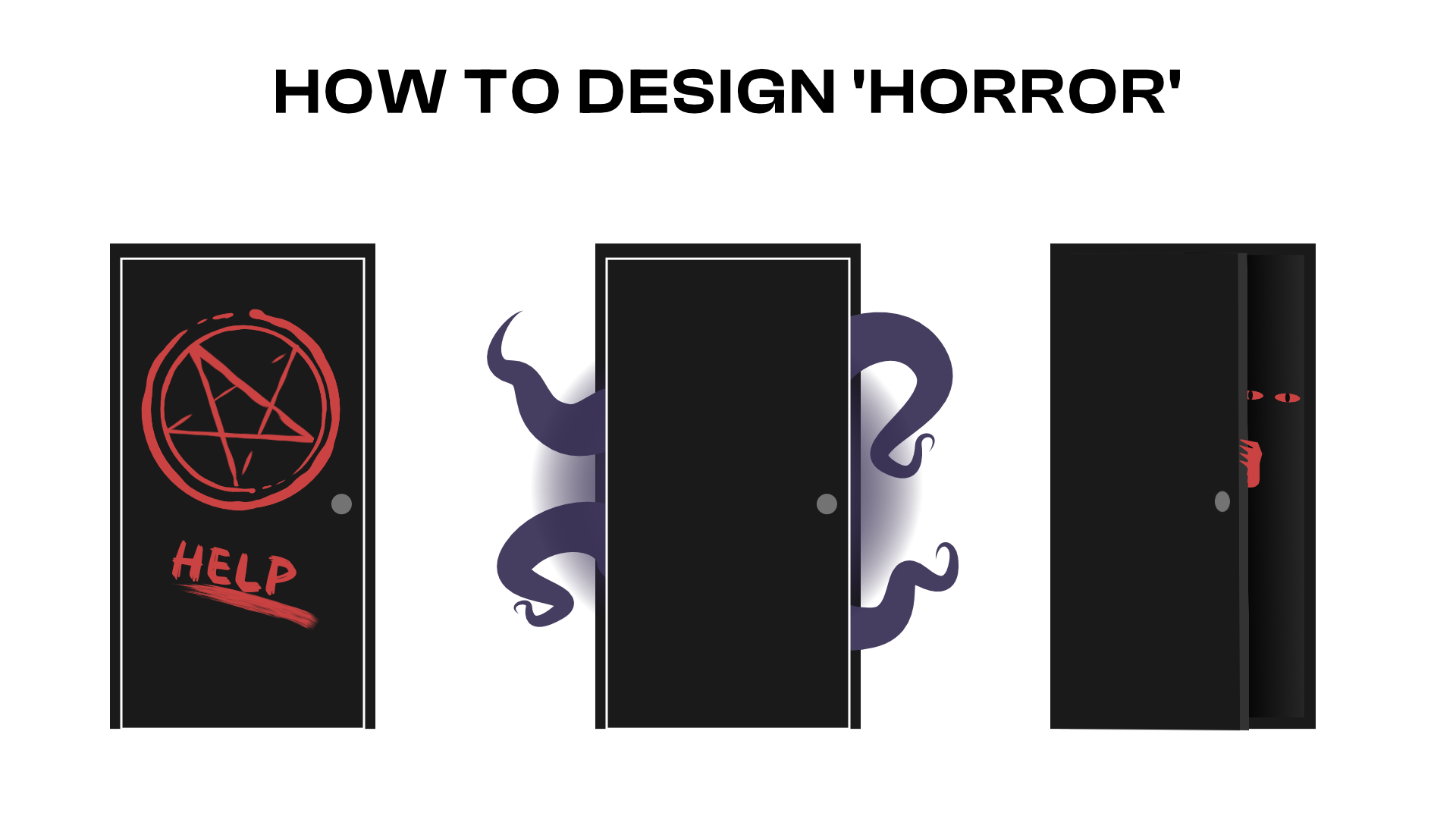
Opening a door in itself is a simple action, but what if the door is covered in blood? What if before opening the door you saw something close it shut? What if the door is already half open and as you approach it you hear something coming from inside the room?
In this case I am using opening a door as the action because it’s something you do a lot in horror games, but it can be any action the player takes. The idea is to strip the action into 3 moments and decide how the player should feel during those 3 moments: seeing the door (presentation), approaching the door (build-up), and opening the door (pay off).
With these 3 moments defined, we can also try scenarios of how an action focusing heavily on one of those moments would look like. Let’s go through a game scenario to further explain this.
FINDING THE DOOR
Let’s imagine a game where you need to explore a house where some ghost shenanigans have gone down.
You are exploring a haunted house that so far has been slightly creepy. You came in late at night, the lights are off so you make your way through the house finding switches and turning lights on. There is the sound of wind and rain outside and from time to time you hear the house creaking. You go through the rooms trying to find anything out of the ordinary, but everything seems normal. After making your way through the first floor, you go up the stairs and get to the second floor landing to find one of the doors covered with bloody symbols, piles of lit candles piled at the foot of the door. Suddenly everything else is silent, all but a soft wailing coming from behind the door.
The simple act of finding and seeing the door has caused friction. Now you -as the player- might feel hesitant to even approach the door, or if you’re feeling brave you might want to immediately open it and see what’s behind it.
You might stand still for a moment, maybe try some of the other doors, but they are locked and your only option to keep moving forward is to open the door and see what lies ahead.
APPROACHING THE DOOR
Throughout the first section of the game you have been opening and closing doors by pressing ‘E’ on your keyboard. So you walk forward cautiously hovering over the ‘E’ key as the sounds of the wailing behind the door get louder and everything gets weirdly more silent.
As you get closer, you are now able to see more details on the door. There’s blood on the handle, cryptic messages scrawled all over the door and the blood used to draw a massive pentagram in the center of it seems fresh and still dripping.
You have finally approached it enough to look at the handle and see the message prompting you to open the door. But when you try to do so, it doesn’t seem to work. You press ‘E’ again and now this time the wailing behind the door has suddenly stopped. Now there is true silence.
A few seconds pass and you hear a loud sound coming from the first floor of the house, or maybe from behind one of the other doors on the landing.Then you hear a click as the door unlocks and see you a message prompting you to open the door.
OPENING THE DOOR
Everything that has happened up to this point builds open to the actual moment of opening this one door. The atmosphere of the house, the sounds, maybe some music here and there, the finding of the weird door, you get the point. Every interaction before actually opening the door creates an expectation to what will happen when you open it.
Depending on what type of game you are trying to make you can fulfill that expectation or subvert it. Maybe there is a gruesome ritual scene on the other side of the door paired with a jumpscare, or it can be an empty boring room with a piece of paper on the floor with a new objective for your player. Perhaps as soon as you open it a weird shadow crawls out of the room escaping into the house and now you have to deal with that.
The way you manage the first two moments help reinforce whatever you decide happens after the third. Opening a door and randomly getting jump scared will surely work the first time, after a while though it might get exhausting for players. But if you start playing with expectations, changing how players find the door or how they need to approach the door, how players open the door -and their expectations of what will happen- will change as well.
If at some point in the game you give your player an axe, they might feel very brave to open doors. But if the only thing they have to defend themselves is a lighter, well, then they might consider twice opening the door.
The idea is to approach this door theory -pun intended- with other aspects of the game, not purely opening doors. If your game is about exploring and interacting with the environment in simple ways then yes, the door analogy works more directly, but this also works if your game has combat.
If you give your player the expectation that combat should truly be a last resort with the ‘finding of the door’, you can create moments of friction by forcing them to avoid or enter combat, while fully knowing that the best combat tactic might just be running away and hiding. Games like Alien Isolation do this beautifully by pairing you off against a clearly stronger opponent, and you slowly start to learn how to approach and open the door to combat with the titular Alien.

Try to do the exercise of looking at some horror games with the door analogy in mind. Play the games yourself or watch a let’s play, try and find in what ways the developers approach the 3 moments that I believe are key to designing a good horror game.
I would highly recommend using The Mortuary Assistant or the P.T demo by Hideo Kojima as examples. Finding a way to play the later one might be hard, but even just watching a let’s play will work. In my opinion these games do a great balancing act of constantly changing how you interact with ‘the doors’. Seeing things just out of sight, feeling uneasy when going from one room to another, putting you in a spot where you have to open a door you really don’t want to open and sometimes just opening the door for you while you are left squirming wondering if now that the door is open if you really want to walk through it.
This -like many tools and advice for game design- is meant to help you approach design with a different perspective, and it might or might not help you actually do that. What works for one person might not work for another. I’ve come to find that this door analogy helps me think of player interactions in a different way, one that is helpful for horror games specifically, but it also works for other types of games.
Let me know with a comment if this exercise helps you see horror games with a new perspective or hey, maybe tell me if you have any tricks or different ways of analyzing mechanics in horror games.
Have fun, and go make some games!




Leave a Reply